Deborah R. Fowler
Houdini Overview - what is Houdini and
how does it work
This page is a topic-organized index into the deeper guides on this site — proceduralism, modeling, animation, look dev, and pipeline. If you are just getting started, visit the Quick Guide first. For curated external tutorials, see the Tutorials Directory.
An overview of commonly used techniques in Houdini from a personal perspective — opinions freely given. For greater depth see the official SideFX documentation. This site focuses on three areas:
- non-destructive node-based proceduralism
- dynamics
- VEX / VOPs
Getting Started
- General Concepts
- General Concepts (page format)
- What You Should Know
- Terminology
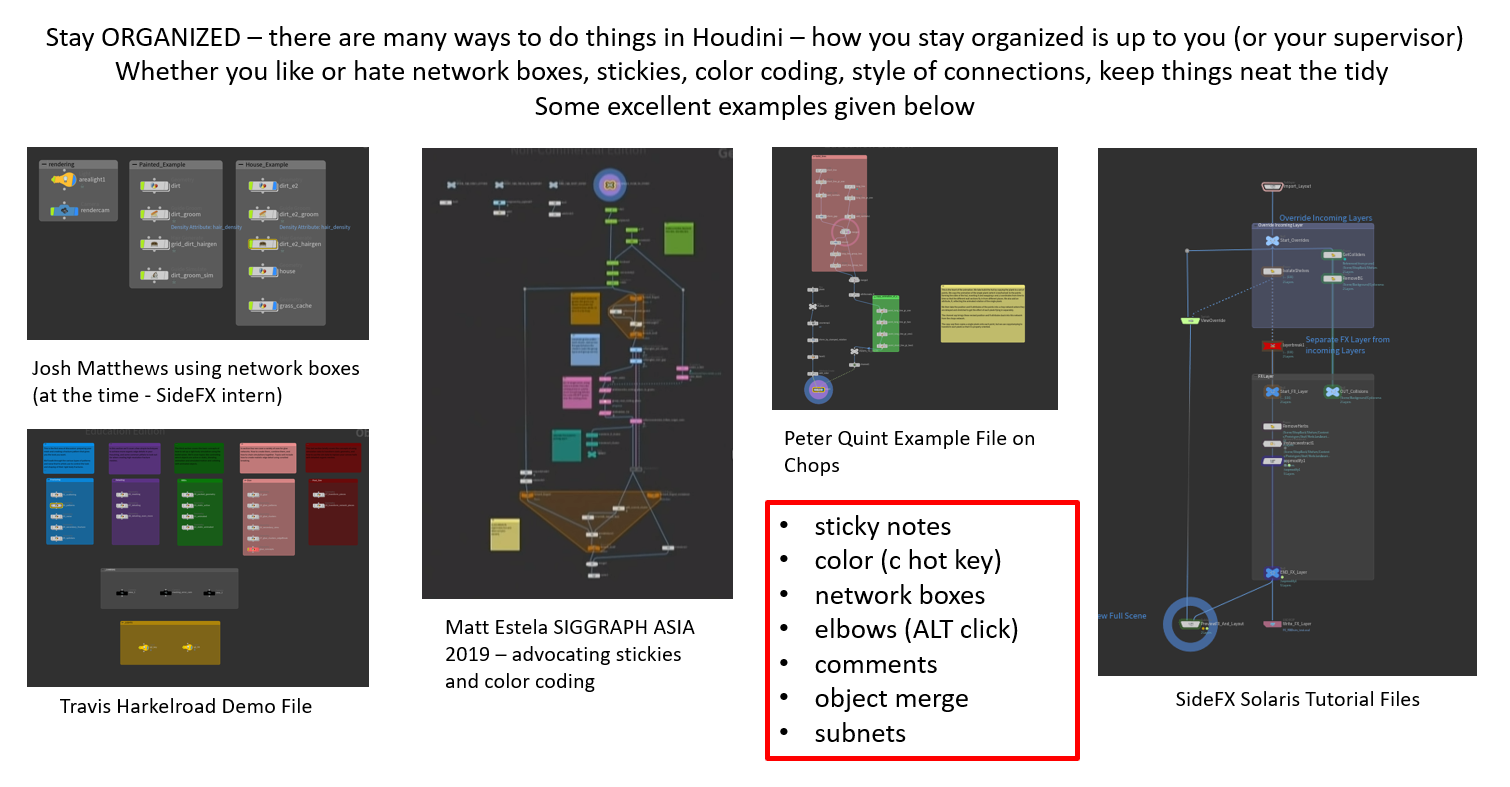
- Stay Organized
- Troubleshooting Guide
- Good Habits (advice for beginners)
Procedural Repeated Elements
- Looping — For-each, Point Wrangle, Python
- Copy Family
- For-each
- hiplc copyingAndMultiLingualHoudini.hiplc
Procedural Modeling
- Modeling in Houdini
- Procedural Building
- Bend Node Example
- Example of Modeling
- Basic Fracturing
- Mocap Marker Fun
Layout
- Instancing / Layout (H22 UPDATE)
- hiplc InstanceIntro19.5.hiplc — Mantra/Redshift
- Instancing with USD
- Packed Primitives — Instancing is powerful, but packed primitives are cooler
- Procedural Corn Maze — Scott Keating — Dated but a solid instancing walkthrough
- Complex Scenes
Look Dev
- Lighting Intro
- Lighting in Various Renders — Redshift, Karma, Mantra
- Karma and Houdini
- Shading in Houdini IN KARMA
- UVs in Houdini
- Texture Overrides IN KARMA
- Copernicus Overview
- Extracting Information from Images
- COPs Examples
- Simple Color BG: hiplc compImg.hiplc hiplc compCopernicus.hiplc
For serious compositing use Nuke; Houdini's in-app network is handy for testing layers/passes without leaving the package.
↑ Back to top Procedural Animation
↑ Back to top
Pipeline & Output
↑ Back to top
Tools & Resources
↑ Back to top